Citizen developer
Builds applications by talking to a coding agent. Doesn’t write Dockerfiles. Doesn’t touch Kubernetes. Knows the business problem; trusts the platform to make the app real and safe. → For citizen developers
Overview
Greenlight is an app platform for coding agents. Vercel-style infrastructure, purpose-built for the agents your citizen developers already use — Codex, Claude Code, Cursor, Copilot, Gemini, or anything else that speaks MCP.
Citizen developers stay focused on the app they want to build. Their agent works with Greenlight on the rest: source control, deployment, data access, SSO, RBAC, network isolation, audit logging, and policy enforcement — the technical work that turns a local prototype into a real, governed application.
See how it works Security posture →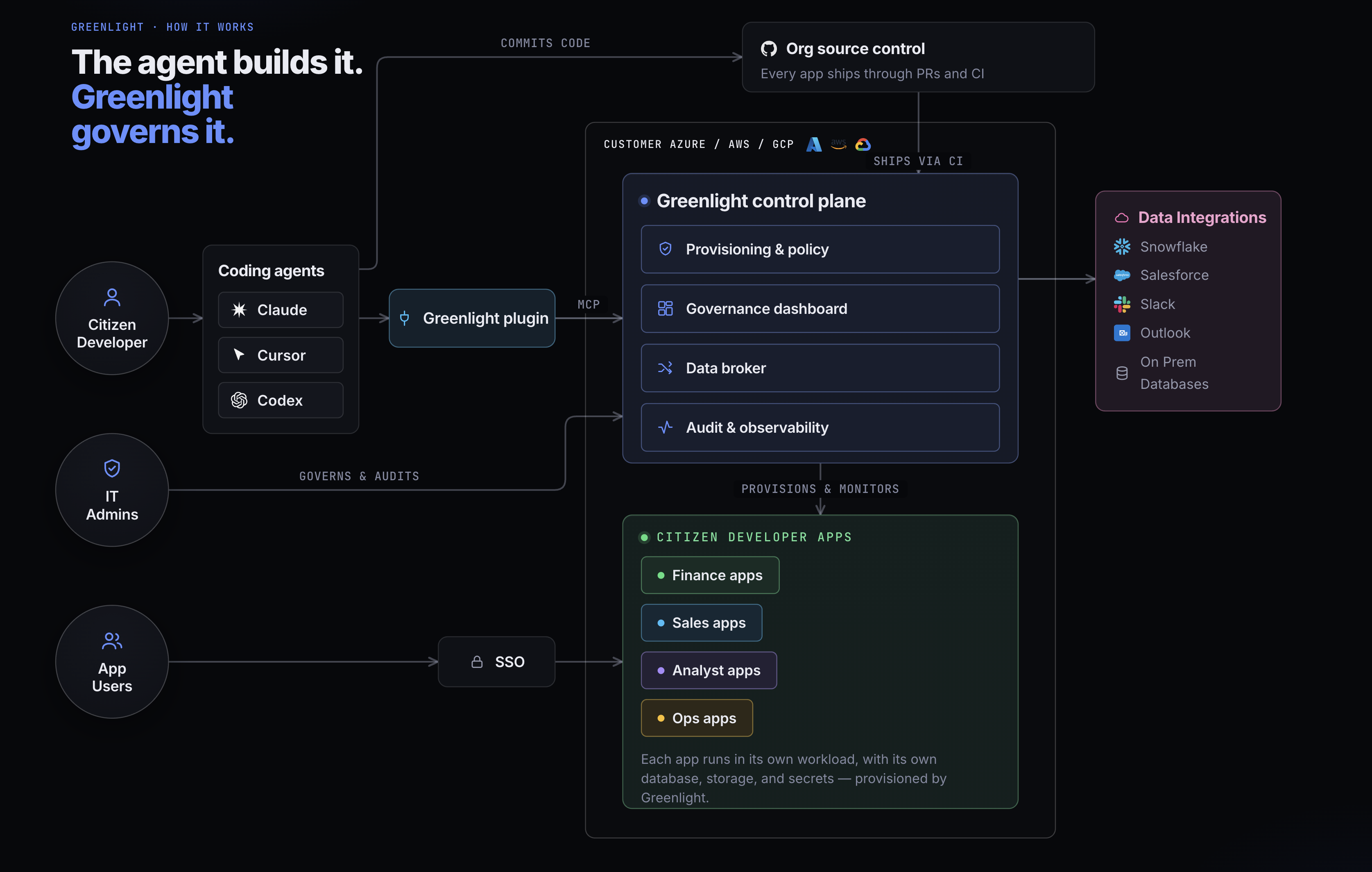
A citizen developer asks their coding agent to build something. The agent reads the right context from Knowledge, generates code, and opens a pull request in a repository owned by your team. Greenlight’s policy check evaluates the change against your organization’s rules and blocks merges that fail. When the change merges, Greenlight builds and deploys the app into an isolated environment, attaches a workload identity, and wires it into the configured data broker.
Citizen developer
Builds applications by talking to a coding agent. Doesn’t write Dockerfiles. Doesn’t touch Kubernetes. Knows the business problem; trusts the platform to make the app real and safe. → For citizen developers
IT admin
Owns the install, the integrations, the audit log, and the kill switch. Operationally literate. Says yes more often when yes is auditable. → Admin guide
Coding agent
Speaks MCP. Reads Knowledge for context. Calls platform tools to register apps, propose policies, open pull requests. Has scoped powers — never god-mode. → The agent protocol
End users of the built apps just see the app — they sign in through your identity provider and never touch the Greenlight dashboard, the agent plugin, or any platform tooling. Most apps deployed on Greenlight today are internal employee-facing tools; externally accessible apps are on the roadmap and will introduce additional identity, ingress, and rate-limit controls.
No. Every change is a pull request, and every pull request runs through Greenlight’s policy check before it can merge. The check covers committed secrets, dependency vulnerabilities, an approved base image, and your organization’s policy rules — and nothing reaches production unless it passes.
Apps deployed on Greenlight are real code in real repositories your team owns. There is no proprietary visual editor and no platform lock-in. The agent writes the code, but your developers can read it, fork it, and run it on their own infrastructure if they ever need to.
The opposite. IT gets a real-time view of every app, every integration, and every credential. A single action can stop any app instantly, and every override is logged. Greenlight’s role is to put guardrails between citizen developers and your production systems — not to remove them.